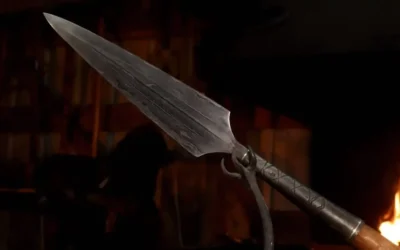
Spears.. A prehistoric war and hunting tool
Humans have known the spear since ancient times, and used it to hunt animals. The ancients used pointed stones by tying them to the head of a long stick, forming strong spears. Archaeological evidence today finds wooden spears that were used for hunting at least 400,000 years ago.

A study published by the Kato website said that South Africa witnessed the development of stone-tipped spear technology in Africa about half a million years ago. Historians say that as early as 200,000 years BC, Stone Age humans began making complex stone blades with scaly edges used as spearheads. These heads could be attached to the spear shaft with glue, resin, or ties made from animal nerves, leather straps, or plant materials. There was also a clear difference between spears designed for throwing and those designed for use in hand-to-hand combat.
The spear is a tool of war. It is a wooden or metal stick with a pointed piece of metal at the end. There is a type of wooden spear that can be sharpened with a knife or sharp tool to become a spear without placing the iron piece, such as a bamboo stick. But the most famous spears designed for hunting or fighting in ancient times were spears with a triangular metal head. Spears can be divided into two different types: spears designed for combat, and spears designed for throwing.
Calligraphic spears are considered the most famous and finest type of spear among the Arabs, and the Arabs in pre-Islamic times and after Islam always sang about calligraphic spears in their poetry. It was named after the region in which these spears are made, which is Al-Khatt.

Some people used spears for hunting in ancient and medieval times, and they were often used to catch mammals and fish. The spear accompanies the sword in many locations, as it is also called the qana, and its plural is qana and qanawat, while the spear man is the spear maker, while the spear man is the spear bearer.
In addition to its many uses, the traditional sport of javelin throwing has emerged, as it is practiced by the athlete who uses, in addition to the force resulting from rotation, the force of transformation, i.e. the thrust force that is transmitted to the javelin due to the speed of the body and arm. He starts running quickly for a distance of about 30 meters, and when he reaches the throwing position, he begins to slow down his enemy, while the arm and shoulder carrying the javelin retreat to the maximum extent to the back, with a violent turn, and with a strong push with the trunk and arm The racer throws the spear.
The spear is thrown during competitions, to achieve the longest distance in a special way, in which the speed of approach and the special technical conditions are interconnected, which help the spear to gain the maximum launching power for the longest possible range, while the technical steps of throwing the spear go through multiple technical stages that the player must master, to reach the appropriate level, which are: Holding the spear, preparing, approaching, throwing steps, serving, and maintaining balance after throwing. A throw is only considered valid if the metal blade of the spear touches the ground before any other part of it, while an attempt is not counted if the spear is broken. The time each throw is measured immediately after the throwing process from the closest trace left by the spear tip on the ground to the inner border of the throwing arc.
Spear.. It was developed by the Greeks and eliminated by firearms
Numerous studies have revealed that the manufacture and use of spears is not limited to humans. Chimpanzees in Senegal have been observed making spears by breaking the straight ends of trees, stripping them of their bark and side branches, sharpening one end with their teeth, and then using it to catch sleeping galagos.
The spear was the main weapon of Homer’s warriors, while in the 7th century BC the Greeks developed a new, more closely spaced infantry formation, the phalanx. The key to this formation was the hoplite, which was equipped with a large circular shield with a bronze face (aspis) and a 7-9 foot spear with an iron head and a bronze handle. At a time when the 4th century saw major changes, one of which was the greater use of shells, while infantry was armed with spears, which were also used by the ancient Romans, where commanders were armed with a short spear called a hasa. In the late Roman Empire, the spear became in frequent use due to its anti-cavalry capabilities, as barbarian invasions were often carried out by people with a well-developed cavalry culture in warfare.

The use of the spear would pass through the medieval period following the fall of the Western Roman Empire. Since the medieval spear required only a small amount of steel along the sharp edges, and most of the spearhead was wrought iron, it was an economical weapon, quick to manufacture, and required less blacksmithing skill than a sword.
There are several types of spears, most of whose heads in the Middle Ages were leaf-shaped. Notable types of early medieval spears include the angon, a long-headed throwing spear similar to the Roman pilum, used by the Franks and Anglo-Saxons, and the winged spear, which had two prominent wings at the base of the spearhead, either to prevent it from penetrating too far into the enemy or to aid in the spear’s fencing. There is the push spear, which has access As it is much longer than other types of weapons.
Some countries were famous for their long spears, including the Scots and Flemings, and spears were usually used in tightly arranged formations, such as a shield wall or a schiltron. To resist cavalry, spear posts could be planted on the ground. Cavalry spears were originally similar to infantry spears, and after the adoption of high knees and saddles, the spear certainly became a more powerful weapon, because height allows the knight to focus and maintain accuracy and control.
As the development of weapons put an end to the spear, firearms in the European Renaissance saw an increasing emphasis on integrated infantry tactics using the bardo. At the beginning of the Renaissance, cavalry remained armed with spears, and when the 1540s arrived, cavalry began to be pistol and light firearms, along with the sword, effectively replacing cavalry in Western Europe by the beginning of the 17th century.
Many countries have used it for many years
The King of Arms supports martial arts
The spear has survived in many countries around the world, which have used it under various names. Muslim warriors used it as a zawiya, pronounced “zaya” by the Berbers. However, the English term, derived from Old French via Berber, is “asigai,” which is described as a pole-shaped weapon used for throwing or hurling. It is usually a light spear or one made of solid wood and pointed with an iron tip. It played an important role during the Islamic conquest and later in the 20th century.
Multiple forms of the longest corner column were made in South Africa and the Indian subcontinent, with it being used as a hunting weapon on horseback, and this spear was the weapon of choice during the Fulani jihad, as well as during the Mahdi War in Sudan, while it is still used by some Sufis.
In China, the spear was known as the “qiang,” as it was used in Chinese martial arts, and was popularly called the “king of weapons,” because it worked alongside all automatic and white weapons. Spears were first used as hunting weapons among the ancient Chinese, and became more popular with infantry in warfare, while during the Qin and Han periods, long spears were used closer to the spear in formations similar to the Swiss Beccans in order to ward off cavalry.

Indian society used spears in the form of rockets, both by knights and infantry soldiers, and spear fighting was practiced using a ten-foot wooden spear with a spherical head, the end of which was covered with dye so that the strikes could be confirmed, while spears were constructed from a variety of materials such as Singing made entirely of steel, and balam, which had a bamboo pole. At a time when the Arab presence in Sindh and the Delhi Mamluks introduced Middle Eastern spear throwing to India. The only spear unique to India was the vita or rope spear. Locally made spears are used in conflicts and riots in India’s northeastern states.
Among the countries that used spears was ancient Japan during the Yayoi and Heian periods, but it became undesirable early on for samurai. In the Middle Ages, the Japanese used spears again for use by infantry soldiers, who preferred them to bows, and samurai used them on horseback in combat when the enemy was close. Philippine spears, also called “slave” as a weapon and tool throughout the Philippines, are usually made with a sharp head or made of metal, and have sharp, double-edged, or spiky edges.
In African countries, various types of light spears made of wood or iron were used. It was the most common weapon before the introduction of firearms, such as the Zulu, Khoza, and others. South African tribes are famous for using it to attack enemy formations before approaching a close battle. This tactical combination emerged during military reforms.
Because advanced metallurgy was largely unknown in pre-Columbian America outside western Mexico and South America, most weapons in Central America were made of wood or obsidian. This does not mean that it was less deadly, as obsidian could be sharpened several times sharper than steel. Spear throwing was also widely used in the Mesoamerican War, at a time when most spears made by Native Americans (Red Indians) were created with materials surrounded by their communities, and usually, the spear was made of a wooden stick, while its head was made of metal pieces such as copper or bone that had been sharpened. It was used by Native Americans to kill buffalo.
Spears vary in that they have rods containing a crossbar below the blade, to prevent deep penetration of the spear into the animal during hunting. Spearfishing is still practiced in the United States, although trophy animals such as big cats are hunted with bayonets, and alligators are hunted in Florida with a type of bayonet. Like many weapons, the spear may also be a symbol of power. In classical Greek mythology, Zeus’s lightning bolts can be interpreted as a symbolic spear. Some attribute this interpretation to the spear, which is closely associated with Athens, and translates its spear as a symbolic association with some of Zeus’s power, while the Romans and their early enemies forced captives to walk under the “yoke of spears” to humiliate them.
Multiple names for the Arabic spear
The Arabs gave many names to spears, based on their interest in them and their use in horsemanship, fighting, and stabbing with spears, as the names differed according to the different source of making the spear and its characteristics, which indicates their interest in the smallest details about it.
Among the most famous names for the spear are “Al-Amel”, “Al-Assal”, which is a very turbulent spear, and it is also called Al-Aras, “Al-Zaghb” in reference to a person named Zaghb who used to make it, and “Al-Samhari” in reference to a person named Samhar who used to make it, as Al-Mutanabbi said: “And leave the Samhar spears humble.. There is no way out of it to stab and I am smarter. While the spear is also called “al-Sadiq”, it is a solid, soft, straight spear, which if its owner shakes it, it does not bend, and if he stabs it, it does not split.
The Arabs also called the spear “Al-Khati”, which is attributed to Al-Khatt, which is a port in the land of Hajar. It was said that it is an island in Bahrain that was a port for spear ships coming from India, or from southern Persia. Likewise, “Al-Yazni” is attributed to King Dhi Yazan, and it was said that he was the first to adopt iron teeth, so they were attributed to him. “Al-Rudini” is attributed to Rudeina, the husband of Samhar, who used to make spears, and Rudeina used to sell them.
The spear is called “al-Asmar”, which is the greatest spear that is thirsty for water; “al-Dhabel”, which is the soft spear; “al-Ladhm”, which is the spear with a penetrating tooth; “al-Manjal”, which is the spear with a broad tooth, in reference to the “Najl”, which is wide; “al-Thalab”, which is the masked spear; “al-Muthaqaf”, which is the spear whose stick is straightened. If it grows flat and does not need straightening, it is called “Sa’dah”, the plural of “Sa’ad”, which is the channel of the spear; and “al-Ali”, which are the spears that enter a third of the tooth.
As for the parts of the spear, the Arabs gave them precise names. There is the shaft or factor, which is the entire body of the spear from top to bottom before the blade is mounted on it, and the heels, which are the knots that are in the branch, then straightened until they become smooth. As for the stick, it is an iron rod with a pointed tip at the bottom, which helps to secure it to the ground. It is also used to stab it in battle when needed if the tooth is broken.
The parts of the spear are the “high” part, which is the highest part of the spear next to the tooth, up to the size of a third of it. They call it the shaft of the spear, and it has no known limit. The “tooth” part is the part that is mounted above it for stabbing. It was made from the horns of wild cows, then it became made from good, pure iron. The “alopecia” part is the lower part of the tooth into which the top of the spear enters, while the “zebra” is the end of the tooth pointed from above. The “mahrak” part is the “mahr” A round piece was placed at the top of the teeth, where it would rattle when the knight shook his spear with the intention of showing off or to terrorize his enemy before stabbing him with the tooth, while the “axis” was the screw that held the tooth, and the “blade” was the edge and tip of the spear.
The spear has a great status in the Sunnah of the Prophet
There are different narrations about the number of spears of the Noble Prophet – may God bless him and grant him peace – as Ibn al-Jawzi says in the books “Talqih Fahum Ahl al-Athar” that the Prophet had three spears whose names I have not seen, and some of them said four, and there are those who counted them as five.
The spears of the Prophet – may God bless him and grant him peace – have names, the first of which is “al-Mathwi”, meaning that the one who is stabbed is placed in its place, and in “Lisan al-Arab” it is said that the name of the Prophet’s spear was al-Mathwi; From the word “thawa” means residence, so the resting place was called by it, because it confirms the one who is stabbed from the word “thawa”, which means residence, and the second spear is “al-Muthanna”, and historians have differed about the name of this spear. Likewise, “the remaining three”, which are the third, fourth, and fifth, as it was mentioned in “Al-Tabaqat” that the Messenger of God – may God bless him and grant him peace – hit three spears from the weapons of Banu Qaynuqa.

Spears had a place with the Messenger of God – may God bless him and grant him peace – and his nation after him. As for him, it was stated in what Al-Bukhari narrated in his Sahih on the authority of Ibn Omar, who said: The Messenger of God – may God bless him and grant him peace – said: “I was sent before the watch with the sword, so that God alone would be worshipped, with no partner for Him. My provision was placed under the shade of my spear, and humiliation and degradation were placed on whoever disobeyed my command, and whoever imitates a people is one of them.”
Popular poetry has played a major role in preserving ancient Arab history by employing vocabulary that explains certain customs and traditions. In this regard, popular or Nabati poetry discusses some of the traditional weapons used in wars and invasions. The spear and the sword were talked about by poets because they were so impressed by courage and achieving heroism.