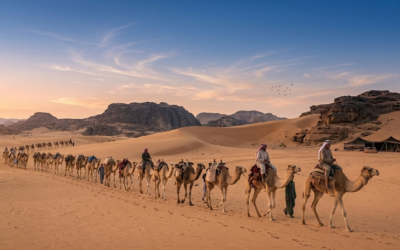
Different environments and characteristics
Deserts.. The magic and love of nomadism
The desert has its magic, its melodies, and its companions. It is a special love for some people, who live their most beautiful moments in it, despite the differences in its environments and characteristics. In general, it is a large, very dry area, containing scattered and harsh plants, some of which are devoid of plants. However, in the eyes of its lovers, it is comparable to lush gardens.
There are many types of desert environment, classified on the basis of: hot, dry, semi-arid, coastal, and cold regions. The hot, dry desert environment is located near the equator. One of the features of the desert climate in these environments is the high temperature throughout the year, reaching the maximum temperatures during the summer months, while plants in hot, dry desert environments are characterized by their ability to live during long periods of drought, and during very hot days and cold nights Plants that grow close to the Earth’s surface often thrive in these environments. Animals, on the other hand, adapt by living underground in search of cooler areas, and few of them only avoid the heat of the day to emerge from their hiding places at night.

The semi-arid desert environment is defined as environments very similar to hot, dry desert environments, as it has long, dry summers and receives small amounts of winter rain. It can be said that these ecological habitats are similar to forested forests and grassy areas, and plants adapt to these environments through the thorns or hairs that grow on them, covering the surface of the plant and reducing the plant’s loss of water.
While the coastal desert environment is characterized by cold winters followed by long, warm, moderate summers, temperatures in the summer range between 13°-24° degrees Celsius, while they drop to 5° degrees Celsius, or less in the winter, so that the maximum temperature in the summer reaches about 35° degrees Celsius, and in the winter 4-° degrees Celsius. As for the rainfall rates in these areas, It ranges between 8-13 cm annually, and the maximum annual rainfall obtained by these areas was 37 cm, while its lowest value was 5 cm. Coastal desert soil is characterized by being fine-grained with moderate amounts of salts.
Coastal desert environments contain a greater number of animals than hot, dry, and semi-arid environments. This is because the climatic conditions here are not as harsh. Mammals, some amphibians, birds, and reptiles are animals that have adapted and evolved in response to coastal desert conditions.
In contrast, the cold desert environment is distributed in the Antarctic region, Greenland, and the New Arctic region. The winters of these environments are characterized by being cold, and many snow and rainfalls occur in them. The summers are characterized by their short duration, humidity, and moderate warmth, in addition to some rainfall. Winter temperatures range between 2-°-4° degrees Celsius, while summer temperatures range between 21°-26° degrees Celsius As for rainfall, its annual rainfall rates range between 15-26 cm, and its limit has reached about 46 cm, and its minimum has reached 9 cm. The soil of these environments is characterized by being dense, clayey, and salty, and by having relatively good porosity and good water drainage.

Cold desert environments are characterized by a scattered vegetation cover, with plants covering 10% of the shady areas in these deserts, sometimes reaching 85%. Deciduous trees are the dominant plants, adapting to cold environments through their spiny leaves. Shrubs or low-lying trees are the most common plants, and the height of plants in this environment ranges between 15-122 cm. Animals adapt to cold desert environments by digging burrows underground to protect themselves from the cold.
There are many characteristics of desert environments that differ depending on their presence on the surface of the Earth and the climatic pattern that characterizes them. However, they share high temperatures, although some of them may be characterized by a very cold climate, such as the Antarctic Desert, which is considered the largest desert in the world. While some desert environments receive larger amounts of rainfall, all of them have rainfall rates of less than 25 cm annually It also loses rainwater quickly due to high evaporation rates.
There are main features of the desert habitat: low annual rainfall rates, large changes in temperature during the day, high evaporation rates, soil roughness, and plants are resistant to drought.
In the Arabic language, the desert is known by many names, including: desert from desert and desert, with a red color that turns to dust. It is also called Badia because it appears flat to anyone who sees it, with no heights. It is also called Bida because it destroys anyone who visits it. It is also called Mafaza, meaning dangerous, for anyone who crosses it. It is also called Fala, meaning wide land with no plants or water.
The most famous deserts in the world are: the Antarctic Desert, also known as the Cold Desert; the Arctic Desert; the Rub’ al Khali Desert; the Great African Desert; the Gobi Desert in Asia; the Arabian Desert in the Middle East; the Syrian Desert; the Great Victoria Desert in Australia; the Kalharry Desert in Africa; the Great Basin Desert in America; and the Patagonian Desert in South America.
Deserts represent a very large percentage of the land area, and this area can be exploited to help people get out of the narrow space of agricultural land, and exploit the desert to be a wealth for the state. The desert is developed by providing the exploitation of its natural resources in the ideal way of oil, coal, manganese, and gold, in addition to thinking about establishing and creating new cities, where all the necessary requirements for life are provided, from housing and drink, transportation, public facilities, places of work, as well as places of study Until a person is attracted to live there.
Deserts can also be developed by exploiting vast areas to establish factories, large companies, and giant projects, and exploiting the advantages of the desert environment to serve humans, as the sun must be relied upon to generate clean energy, which is sold at high prices, which generates income for the economy, while ensuring the cultivation of desert areas through the use of technology and modern means of irrigation, which works to increase plant wealth, and exploiting the desert to promote medical tourism.
The desert environment can be preserved in several ways, including: planting shrubs and herbs; digging trenches to collect rainwater and wind-borne grains; encouraging people to take specific roads in the desert with their vehicles; and encouraging residents living in resorts located in desert cities to replace native desert plants that do not require large amounts of water to care for with water-loving grassy meadows.

The source of water in desert environments is groundwater, which is a primary source, and this water is formed as a result of the high porosity that characterizes the sand in the desert, which results in water seeping into the interior of the desert land, and thus it collects in large quantities, forming groundwater. As well as oases that contain large amounts of water, which can be used in the harsh conditions of the desert, and rain is rare.
Skiing, drifting and racing.. The most famous desert sports

Many people practiced their sports hobbies in the desert, especially those who love sand skiing, car drifting, and various races, including parachute riding, hiking, and other sports.
Sandboarding is a sport practiced on sand dunes rather than snowy mountains, and it has followers all over the world, especially in desert and coastal areas that contain sand dunes. Although this sport is less popular than snowboarding, due to the difficulty of making and installing elevators on sand dunes, it has its pioneers, and sandboarding can be practiced throughout the year, while snowboarding takes place during specific seasons of the year.
Drifting is at the forefront of the sports that many people live in, as this sport is practiced prominently in the Gulf countries due to the nature of the desert environment, with the participation of a large number of young people who come to show off their skills and perform a group of show movements, which sometimes turn into fatal accidents. There are also many international competitions that are held on the desert sands, such as the “Dakar” Rally.

In addition to desert car racing, there is camel racing, as an authentic Arab sport, as well as in Africa and Australia. Some countries, especially the Kingdom, the Emirates, Qatar, Jordan, Oman and Egypt, are keen to hold this race regularly. It is a sport that Arabs have inherited from one generation to another throughout the ages and times, as it is a valuable, ancient heritage that is appreciated by present generations, who place it in the position it deserves. Many describe it as an ancient, modern sport Or the sport of our ancestors that arouses enthusiasm and competition among young people in the modern era.
Desert parasailing has its fans in various countries around the world. Young people have invented it, taking advantage of the moderate climate and moderate desert winds that blow during these times. Far from being a desert adventure based on body balance and the size of the parasail, this sport takes on a different meaning on the sand dunes when practiced collectively. This has paved the way for some to organize teams and competitions for group competition.
Hiking in the desert is considered one of the most beautiful and difficult trips, amidst natural scenery, as it transports hikers to what seems like a different world of silence, while there are some popular sports such as: Ardokh, which is a muscular game such as freestyle wrestling, practiced by two men, with physical entanglement with hands and arms. And scrambling until the game ends with the defeated being knocked to the ground. Likewise, khabit shara, which is a male sport very similar to archery, is practiced by Sahrawis in a regular and organized manner, or during weddings and other occasions.
As for the sport of Gash, it is specialized in lightness, agility, and jumping, as it is practiced by boys and children, and it consists of one of them bending over, placing his hands on his knees, so the players take it as a jumping barrier, and if one of the players happens to touch it, he represents him in this position, and so on.
Research and educational centers concerned with desert communities
Some research centers specialize in developing desert communities, including the Arab Center for Desert Research and Desert Community Development, affiliated with the Natural Sciences and Technology Research Authority, which was established in Libya in 1987 AD. The center conducts scientific research and studies related to developing desert areas and developing desert communities.
Years earlier, the Desert Research Center was opened in Egypt, specifically in 1950, under the name Fuad I Desert Institute, until Presidential Decree No. 90 of 1990 was issued establishing the Desert Research Center, with the aim of exploring the natural resources of the Egyptian deserts. The mission of the Nevada Desert Research Center is to gain a better understanding of the structure and function of the Mojave Desert ecosystem at all levels, and how this function and structure may be affected by changes in global climate.

The Thar Desert Research Center, established in 2017, provides an opportunity for people from all segments of society to achieve better development in all aspects of life, while the Arab Center for the Study of Arid Zones and Dry Lands, established in 1968 in Damascus, operates within the framework of the League of Arab States With the aim of unifying national efforts to develop agricultural scientific research in arid and semi-arid regions and exchanging information and experiences in a way that enables benefiting from the fruits of scientific progress and transferring, developing and localizing modern agricultural technologies with the aim of increasing agricultural production in these regions.
The Jacob Blaustein Institute for Desert Research was founded in 1974. In 1980, the Jacob and Hilda Blaustein Foundation made a generous contribution to Ben-Gurion University, and the institute was named the Jacob Blaustein Institute for Desert Research. The Prince Sultan Institute for Environment, Water and Desert Research was established under the name “Desert Studies Center” as an independent department linked to the Director of King Saud University in 1406 AH / 1986 AD, based on the Kingdom’s government’s interest in establishing specialized research centers, particularly on an important and vital topic related to the dry desert environment prevailing in the Kingdom. The aim of establishing the center was to design and conduct scientific research related to desert development and combating desertification in the Arabian Peninsula.
One educational center is the Desert Research Education Center, which works to promote scientific understanding and protect and preserve the Sonoran Desert Network parks, provides space and support for visiting researchers and trainees, and hosts hands-on experiential learning for local student groups. There is the Gujarat Institute of Desert Ecology, which was established in 1995 AD, and the Desert Knowledge Research Institute, which is interested in learning about the value and development of remote and regional Australia through high-quality applied research that takes advantage of the unique characteristics and strengths of scientific and cultural knowledge of remote, arid and desert areas.
The Institute of Desert Studies, also founded in 1997 as a collaborative program between the Department of Anthropology at Boise State University and Celebration Park, each year offers a wide range of academic offerings of interest and value to students, teaching professionals, Idaho citizens, and visitors.
A wonderful literary heritage of the Arab deserts
The Arabian deserts were associated with unique traditional literary texts, namely the poetic Mu’allaqat, which are still read in the same language in which they were recited hundreds of years ago. The image of nature through pre-Islamic poetry was clearly evident, laden with many details and subtle features that left a prominent impact on the souls of poets at that time.
Nature was a witness that recorded the Arabs’ conquests, victories, numerous journeys, sorrows, and years of love. It was the vast ocean and refuge in which the poet sought comfort and security, as appears in Lamiyat al-Arab by al-Shanfari, which was closer to nature and more attached to it. Their life circumstances condemned them to settle in its absolute corners, and to take it in itself as a home and refuge for him in summer and winter, until he replaced his family with other creatures of nature, such as wild beasts, hyenas, and cows He made the desert land his home, and the sky a roof to shelter him.
The image of nature appeared through pre-Islamic poetry, despite its desert brutality and lack of manifestations of environmental beauty such as flowers and greenery, with special aesthetic privileges that enabled its people to get along with it and the lively blending that made it reflected in their features and character, and their language that acquired a noticeable specificity in most of the words that faded with the disappearance of the manifestations of that pre-Islamic nature, and remained immortal in the horizons of pre-Islamic poetry, including the saying of Zuhair bin Abi Salma:
Amen, the mother of the most loyal addict who never spoke. With the blame of the cyclist and the oppressor
And a house for them in the two numbers, as if they were references and smells in the fountains of Mu’sim
With it the eye and the tumors walk backwards. And its ruins rise from every perch
Athafi Safa’i in a cauldron grist.. A vision like a pelvic leprae that has not been healed

The features of nature in Zuhair’s commentary are charged with emotion, which is sufficient to explain the features of that harsh desert nature in which separation and disappearance have become an essential part. Meanwhile, the image of nature through pre-Islamic poetry is not limited to the homeland that poets lived in and stayed with for a period of time, as nature was able to leave its mark on their souls and be immortalized in their poetry, even if it was merely a passing station. The poets of the pre-Islamic era also unleashed their imagination, declaring their absolute transcendence of all the boundaries of the earth and everything connected to it, in order to make the sky and its stars a symbol of their freedom and absolute ambition.
The inhabitants of the desert have adapted to its harsh conditions, as they are called Bedouins in the Arab world. Life in the desert is characterized by the fact that its inhabitants are nomadic shepherds who live in tents, and live by herding sheep and cattle, and are distinguished by moving from one place to another in search of water and pasture, while some plants live in the desert, such as cactus, as the thorns in the cactus plant form a barbed wire fence, with the aim of providing protection for it and preventing animals from eating it One of the most famous types of cacti that live in the desert is the sijwar cactus, which is the tallest cactus plant, reaching a height of 12 meters.
The desert contains a large number of insects, spiders, reptiles, birds, and mammals. Some wild animals, such as elk, flock to the desert when it rains. One of the most important animals living in desert conditions is the camel.