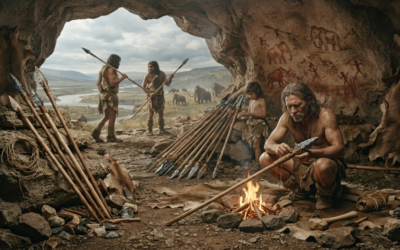
Some specialize in making spears of various types. A simple spear consists of a wooden rod, six or eight feet long, with a sharp knife or scalpel, several feet of rope or strong adhesive tape, and a hammer.
The spear also requires a set of nails, and is the length of the person or a few centimeters longer than him, while the diameter of the wooden rod is between 2.5-3.8 cm. If a person is in the wilderness and wants to make a spear, the wooden rod must be from a living or recently dead tree. The rod must be green, and a knife is used to sharpen one end. Once the spear head is sharpened, a fire is lit and the spear head is placed in it until the color of the wood changes, making the spear more solid.
Some people make spears from a knife. To make this type of spear, a person needs a solid handle. He does not use green wood, but rather dead wood, with a place for the knife open on the rod. This is done by determining where to place the knife, either end of it, then cutting longitudinally from the end to make a place for the knife. After that, the knife is fixed in place and tied with strong adhesive tape or rope.

Spears had different lengths, ranging from four-armed, five-armed, ten-armed, and above, while long spears were for knights, as horses helped them carry them, while short spears (meteorites, chasers) were used by men and knights. The method of carrying the spear was usually arrest, i.e. placing the spear between the stirrup and the legger, with the blade facing up and the stick facing down. As for the Quraysh, they carried their spears on their shoulders.
There are several warnings to ensure the safety of the spear maker and those behind him. Be careful with your hands when using a knife or scalpel to avoid injuring your fingers. After the spear is finished, do not throw it at people randomly, as it is a sharp and dangerous tool and can cause many injuries.
The relationship between spears and horses and courage
The Arabs reserved a place for the spear and some other primitive weapons, such as the bow and sword, which are the weapons of the horsemen, who consider proximity and closeness during battle to be standards of courage, as the spear and bow are used from a greater distance, followed by the sword when combined.

Amr ibn Kulthum says:
We challenge what people have neglected us. We strike with swords when we are covered
Brown from Qena El Khaty to Dun.. Spices, or eggs that confuse us
Amer bin Ma’shar Al-Abdi said:
So we threw spears, and it was a beating.. Elham’s frying pan, everything he tastes
Ibn Harmah explains in one of his poems that conversion to Islam is the last level of war, saying:
He sometimes stabs them with a spear and hits them. With the sword, then he brings them closer and embraces them
While Amer bin Tufayl says:
Al-Maznouk knew that I hated him. On the eve of the wind, the celebrity was honored
If I visit someone who has been struck by spears, I will rebuke him. I told him to come back, coming unplanned
Don’t you see their spears in Sharia law.. You are a horse of glorious sweat, so be patient
As for Antara bin Shaddad Al-Absi, he says:
They call Antar and the spears as if they were.. Ashtan well in Adham’s gum
I still throw them through his throat. And his milk until it leaked with blood
Fazor who signed the canal with his milk.. He complained to me with a lesson and a sigh
There is an arrangement of the stick, and its progression to the spear and spear. The first level of the stick is the shortened one. If it is a little long, and the shepherd, the lame, and the old man are supported by it, then it is the stick. If the sick and weak are supported by it, then it is the “Mans’a.” If there is a ‘aqafah at its end, then it is the “Mahjan.” If it is long, then it is the “harawa.” If it is thick, then it is the “Qahznah” and the “Marzbah.” It is said that it is made of iron. If it is longer than the “harawa” and has a stick in it, then it is the “‘Anza,” while if it has small teeth, then it is the “‘Akaza.”
It is said that if the stick is long and has fine teeth, then it is a “meteor” and a “stalker”. If it is longer and has wide teeth, then it is a “machine” and a “spear”. If it is flat and does not require education, then it is a “salad”. If length and teeth are combined, then it is a “canal”, “salad” and “spear”.
The Arabs call a spear “Azma” if it is dark-skinned. If it is very disordered, it is “Aras”, and if it has a wide wound, it is “Manjal”. If the spear is disordered, it is “Asil”. If its teeth are penetrating and cutting, it is “Lahdham”. If it is hard and flat, it is called “Sadiq”. If it is attributed to a land called Al-Khatt, it is “Khati.” If it is attributed to Dhi Yazan, it is “Yazani,” while the spear plant is called “Al-Washj” and “Al-Marran.”
Spear and bayonet.. Differences in form and tasks

Some people do not distinguish between spears and spears, as there was great confusion among later scholars, because the name spear became a genus name, so the lexicographers included under it what were not spears, even sticks. The name spear also carries a linguistic description, so every sharp, pointed spear and other thing was included under it, while some poets expanded on placing a name in place of a name, either because it is known to people, so there is no fear of confusion, or because of the necessity of poetry.
To differentiate between a spear and a bayonet, we find that each has a specific description. One of the characteristics of a spear is its length, so that it can protect the knight himself and his horse, until the characteristic of length became associated with the spear. Therefore, those described as tall were likened to a spear, which may reach a maximum length of 8.31 meters, while the shortest spear is three meters long, which is disliked by knights.
As for the spear, which people today call “shalfa”, it is not considered a spear, as it differs from the spear in shape and is equal to half of it, and differs from it in action, whether in throwing it or stabbing it closely, whether in combat, slaughtering, etc., as the Arabs did not confuse the spear with the spear.
The basic principle of making a spear is to throw it, as we have mentioned in the texts. It may be used to join the sword in close proximity, so the fighter takes the spear and the shield and stabs the spear closely. It may also be used to slaughter camels.
Museums preserve the history of spears

Museums have focused on preserving ancient spears. The Sharif Museum in Taif houses a large collection of heritage pieces of all types, functions, and materials, with halls for each collection, including weapons such as swords, rifles, daggers, and spears.
The Egyptian Geographical Society Museum includes stuffed animals and hunting tools, including shields and spears, from tribes all over Africa.
The Kremlin Museum, the armory and more than four thousand monuments of arts and crafts from Russia, Europe and the East during the Middle Ages, made to the highest artistic level and of historical and cultural value.
Spear throwing enters the Olympic Games early

The spear entered sports competitions, specifically the Olympics, in 1908 AD, in the fourth session of the Modern Olympic Games in London, where there were two types of throwing: the free method, where the player holds the spear however he wants, and the throwing method by holding the spear from the middle of the fist.
The Sunnah of the Prophet urged teaching children archery, as several texts urged learning archery since the time of the Messenger Muhammad, may God bless him and grant him peace. Al-Bayhaqi narrated on the authority of Ibn Umar, may God be pleased with them both, on the authority of the Prophet, may God bless him and grant him peace, with the wording: “Teach your children swimming, archery, and the spinning woman.”
It was mentioned in an authentic hadith narrated by Al-Bukhari on the authority of Salamah bin Al-Akwa’ – may God be pleased with him – who said: The Prophet – may God bless him and grant him peace – passed by a group of people who had converted to Islam fighting, and the Prophet – may God bless him and grant him peace – said: Throw away the sons of Ishmael, for your father was a thrower. In Sahih Muslim, on the authority of Abu Ali Thamama bin Shafi, that he heard Uqba bin Amer say: I heard the Messenger of God – may God bless him and grant him peace – while he was on the pulpit saying: Prepare for them whatever force you are able, except that the force is throwing, except that the force is throwing, except that the force is throwing.
Archery originated as a means of survival, hunting prey for food. However, in the 19th century, the Industrial Revolution made foraging unnecessary for many people, and archery developed as a sport, especially in English-speaking countries such as England and the United States, as well as Ireland and South Africa.

The spear, then the bow and arrow, were among the oldest archery tools used by man, with which he averted the danger of wild and ferocious animals and sought to hunt. Given the benefits that man has seen in his use of archery tools, he has continued to strive to develop them, just as he has strived to develop his various household tools, agricultural tools, and means of transportation and movement. While historians have agreed that archery has been known to man since ancient times, and that it has developed in the civilizations of nations, they do not agree on those peoples who preceded him in archery.
Ibn al-Jawzi mentioned in the book “Al-Muntazam fi Tarikh al-Umam” that Ibn Abbas said: The first person to make an Arab bow was Abraham – peace be upon him – who made a bow for Ishmael and a bow for Isaac, and they used to throw it and he taught them how to throw. Archery continued to be present in the family of Abraham – peace be upon them – until the time of Joseph. It is mentioned in Surat Yusuf: “They said, ‘O our father, indeed we have gone preemptively and left Joseph with us.'” This noble verse is evidence that archery was practiced in the time of Joseph – peace be upon him – as a sport. It is mentioned in Ibn Kathir’s interpretation of God Almighty’s saying, “Indeed, we have gone preemptively,” meaning: we trampled.
Most commentators believe that the race of Joseph’s brothers mentioned in this verse is that they are racing each other in throwing. Other Arab tribes knew how to shoot and were good at it, and the Banu Tha’al of the Tayy tribes were exemplary shooters. One of the tribes famous for archery is the Qara tribe.