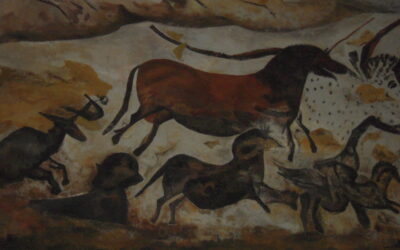
Horses are associated with verses that have become among the most famous sources of Arabic poetry. The Arabs, both ancient and modern, were known for their great passion for horses, and they occupied a great place in their lives. They were proud of them and devoted books and letters to them. They wrote poetry and wisdom about them, and gave proverbs about them.
Horses, in their lineages and characteristics, occupy a large part of Arab thinking and life, and this is only an explanation of their innate characteristics on the one hand, and their adaptation to reality on the other hand. Imru’ al-Qais says, describing the horse in his famous Mu’allaqa:
An upcoming, planned, and terrifying deception. Like a mountain of rock that was blown down by a flood
How much the earth removes from the state of its body.. As the serenity has vanished with the revealed
He is so greedy that his motivation is as if he is wasting away. When his fever is severe, he becomes a man
Anointing those who swim in the world. The dust has risen with the broken work
The boy removes the fear from his awakening. And he waves with the heavy garments of violence
Dirif Kakhudruf, the guardian, ordered him to.. His palms are followed by a connected thread
He had two birds and they gave him sleep. Erkhaa Sarhan and Taqrib Taflaq
Well-versed, when you turn him around, he blocks his private parts.. In addition, the furrow of the earth is not defenseless
It is as if he is on the back of his body when he takes a sigh. There is no bride or prayer for Hanzal
While the great poet Al-Akhtal says:
Love horses and be patient with them. Glory and beauty are in it
If horses are lost by men.. We tied her up and the children participated
We protect horses as long as we are present. And We guide them in travel in sandals

The fame of the verse that says: “The horses, the night, and the desert know me” is not due back.. And the sword, the spear, the paper, and the pen, only because of the fame of its author, Al-Mutanabbi, but because it contains vocabulary associated with scenes of heroism, redemption, and pride throughout the history of our Arab and Islamic nation, as the Arabs remain the first to be interested in the stories of horses, their characteristics, and to be inspired by them in Arabic literature, poetry and prose.
Horses have recorded their presence as a manifestation of daily life among the Arabs, embodied in the words of Antara bin Shaddad:
Would you like to ask the horses, daughter of Malik. If you are ignorant of what you do not know
I’m still on a swimming trip.. A mute, talking hoopoe

Recently, the poet Amal Donqol says in his poem “Horses”:
Conquests on earth are written in the blood of horses
The borders of the kingdoms were drawn by the Sanabaks
And the two passengers: a balance of justice tilted with the sword
Where it leans, run or stand now
Ismail bin Ajlan says about the status of horses:
I have nothing but horses to prepare
Even if I am wealthy from the red dinars
I share my money with her and feed her virtue
My children, I hope to help and be rewarded
If I didn’t have a horse, you would have seen me
Even if I had an insolvent treasure of Qarun
Perhaps the writers of the Arab heritage who addressed the subject of horses the most in their works are Al-Asma’i, Al-Jahiz, Ibn Al-A’rabi, Al-Isfahani, Ibn Al-Athir, the author of Al-Kamil and Al-Tabarani, Al-Asma’i in his book (Horses), Ibn Al-Kalbi in his book (Genealogies of Horses in the Pre-Islamic and Islamic Eras), and Ibn Qayyim Al-Jawziyya in his book (Equestrianism).

The poet Suleiman Al-Nabhani, who was born in the ninth century AH, was interested in horses and described them and was nicknamed the poet of horses, chivalry and pride, belonging to the category of knightly poets, like Abu Firas Al-Hamdani, Al-Sharif Al-Radi, Antarah bin Shaddad, and Al-Mu’tamid bin Abbad. In Al-Nabhani’s collection of poems, there are many poems that glorify horses, especially since he fought many battles, experienced the battlefield, and achieved many victories over opponents of his rule, so he rose up to sing of his events, and was experienced with intensity and steadfastness in confronting dangers His poetry shows a clear picture of the visuals, and almost depicts the battle in its parts and details in a realistic, unimaginable way:
I put on my negotiating shirt confidently
On the outside, the life-giving, the deadly, the inner
Jafla and Al-Ramah rode the streets
Horses between conflict and challenge
The knights weakened from me when they saw
Haider’s campaigns against the Hawazin invaders
Al-Nabhani devoted several poems to horses, and the names of his horses were many, including his famous horse, Jafla, which he mentioned in more than one poem. He also devoted more than one poem to his horse, Al-Ghurab:
All precedents fall short of the crow’s running
I have defiled him, so if he had time, he would have preceded the godfather of barrenness
The pure skin is as if a mirage is running through its stomach
While he devoted entire poems to describing horses and how much he loved them, saying:
Horses are the best thing you can do and pretend
The best wealth is that which is used for hardship and benefits
They are strongholds, but they are ships
She saves her passenger if fear abounds
Horses are the most successful horse in the cave
The people of hadith and the steps of the Qana are the law
Al-Nabhani’s chivalry is completed by his cruisers. He frequently writes poetry about cruisers, sniping, and describing hunting trips. He has many poems on this subject, the most beautiful of which is this long poem with its epic narrative spirit, which describes the hunter, his dogs, and the wild cow bull in an animated pictorial description. Through this image, he projects the scene onto himself, chasing and defeating his enemies.
Horse trade.. Popularity, fame and high profitability
The Arabian horse trade in the world has become one of the most popular, famous and profitable types of trade, due to the high demand for it, especially by the rich, wealthy and kings who are keen to acquire it and obtain purebred Arabian horses with pure and clean blood.
Many reports have spoken about the most famous horses in the history of racing, including the “Phar Lap” horse, or “Lightning” in Thai. This giant horse, in name and size, managed to achieve 37 wins during its participation in 51 races, before its mysterious death in 1932, and achieved eight records in its races. It was distinguished by its great length, as its height reached 1.7 meters, and the weight of its heart reached six kilograms, compared to four kilograms for other horses.

John Henry’s horse was nicknamed the “Horse of the Eighties”. He was the first horse to exceed a total profit of four million dollars at the time. After 39 wins, he achieved first place in the “Arlington Million” and “Santa Anita Handicap Avtar” races. He retired in 1985. While the horse “War Admiral” is the son of the famous horse “Man O’War”, as he won the “Golden Crown Triathlon” races with the title of Horse of the Year in 1973 AD.
The horse “Affirmed” emerged in 1978 when it won the “Golden Crown” triple races, and in 2006 the horse “Barbaro” entered the Kentucky derby races without any defeat, and this achievement was the largest in fifty years. As for the horse “Secretariat”, it was born in 1970, and just two years later it won the title of “Horse of the Year”, and achieved a record winning time in the “Bellmount Stakes” race, which it still maintains today.
In contrast, the horse “Smarty Jones” achieved advanced ranks in the “Kentucky Derby” and “Breakness Stakes” in 2004, making the horse an icon in the world of sports, and he also appears on the cover of “Sport Illustrated” magazine at the age of four.
The horse “Citation” was born in 1945 AD, and won the “Golden Crown” triple races, and at the age of two years, the horse entered its first race to win a million dollars, and its fame filled the horizons, and a statue was made for it in Florida Park, and in 1951 AD it was included in the list of racing celebrities in US National Museum in 1959 AD.
The potential of the horse “Seabiscuit”, the grandson of “Man O’War”, did not appear from the beginning in the field of racing, but he proved his abilities in 1937 AD when he was able to win 11 races out of 15 races, becoming a symbol amid the American economic depression. Man O’War is credited with saving the American equestrian racing industry in the 1920s. Born in 1917, he competed in his first race two years later, winning three major races in just 17 days.
Many previous horses are related to the breed of this horse, which died in 1947 and was buried under a statue made especially for it. Several books were written about it, and it was inducted into the Racing Hall of Fame in 1957.
50 games played on horseback

The use of horses does not stop at racing and equestrianism only, but there are a large number of sports that can be practiced on horseback, amounting to about 50 games spread around the world.
The first sports practiced on horseback are show jumping, polo, which is a team game played from above horses, in addition to the sport of taming horses, which is considered the highest sport in the International Equestrian Federation, as both the rider and the horse perform a series of pre-determined movements that are preserved in memory.
Double horse carriage racing, horse endurance racing, horseball, which is a sport that combines basketball, rugby and polo, horse restraint, which is a popular and officially approved sport, rodeo of various types to withstand a wild horse, in addition to batu, which is a sport practiced on Horses combine basketball and polo.
Important steps for raising and caring for horses

Horse breeding requires several requirements to ensure good horse care, including a barn whose floor is raised at least 30 centimeters above the ground to ensure good water drainage. This is of paramount importance to horse health, as moisture that may occur on the barn floor due to waterlogging can damage the horse’s hooves.
The size of the barn varies according to several factors, such as the size of the horse and how long it stays in the stable. A horse weighing half a ton needs a barn with dimensions of no less than approximately three and a half meters to be able to move and sleep comfortably. It is recommended that the walls of the barn be two and a half meters long so that it does not jump out, while low ceilings may harm the horse’s health and prevent air movement well.
According to horse breeding experts, the barn door must be more than two meters high, and between 1.0668 meters and 1.143 meters wide, to be safe for horses to pass through. While the height of the outdoor shelter should be between two and a half and three metres, with an area of ten square metres for each horse, in addition to ensuring that there is sufficient space to feed the horses. The bedding is made of many materials, including sawdust, straw, rice husk, or peanut shell, which are good alternatives to straw and sawdust. The height of the mattress should be ten centimeters if it is a dirt floor, or twenty-five centimeters if it is made of cement or asphalt.
Daily care and attention for horses is extremely important for maintaining their health. It is recommended to clean their hair before and after riding. Daily cleaning and waste cleanup can be taken care of to keep the horses’ stables and barns clean by removing only wet or dirty stable floor bedding. Moisture can also be removed by exposing the horses and equipment to air after removing them from the stable. It is recommended to put lime under the horse’s bedding to resist odors and moisture in the stable.
To maintain the health of horses, they must be trained continuously, and the horses should not be given excessive food and drink immediately after training, as this may cause harm to the horses’ health. In addition, water should be avoided immediately after the horses perform the exercises. However, some sips of water should be given partially, while it is important after training to make the horses walk normally without fatigue, and to clean them of sweat and dirt.
In hot climates, many different methods can be followed to care for horses by placing them in an area away from direct sunlight, or transferring them to a cool, well-ventilated enclosure. Spray the horse’s body with cold water, avoiding spraying the water directly on the face or ears. The temperature of these areas of the horse’s body can be reduced by using a towel soaked in water, and placing ice packs on the blood vessels visible on the horse’s neck and legs.
Cold care requires ensuring that horses are provided with sufficient drinking quantities. Horses need to drink larger quantities of water during the winter to compensate for the moisture content of summer feed compared to that provided in the winter. Increasing the amount of food provided to horses in cold climates provides the horse’s body with the necessary calories to warm and strengthen its body. This is in addition to monitoring the horse’s weight and providing a larger quantity of food if a decrease is observed, and reducing the quantity if the weight increases. The horse stable is also protected from winds and storms, and the horse’s bodies are covered with blankets designated for them.
With the focus on nutritional care, the focus should be on health care by giving the necessary vaccines to horses, such as the Eastern or Western Equine Encephalitis vaccine, the rabies vaccine, and other vaccines, and combating parasitic organisms that may negatively affect the health of horses, such as tapeworms, and conducting annual periodic examinations of horses’ teeth, and taking care of hooves that grow at a rate ranging between (0.6 cm-1.3 cm) per month. As well as caring for horses during pregnancy and lactation by providing the necessary food to provide the pregnant female with energy.
Safety procedures during horse training
Societies needed to use horses in many areas such as transporting passengers and goods, plowing the land, and sports games, which prompted the adoption of various training methods so that horses could perform their tasks in the best way.
According to horse breeders, it is preferable for the horse and its trainer to have a close mutual relationship to enhance its ability to learn. Horse training goes through several stages, starting with approaching and touching the horse to accustom it to accepting the trainer from the early stages of its life, or after weaning. This is done by walking around with it in a small area, placing it in a place and standing near it to watch it. Usually, curiosity will push the foal to approach the trainer, and then the trainer can start touching and scratching the horse’s groin Until he starts to relax and feel safe and comfortable, he kisses his trainer, and then controls him.

The next stage is to install the halter on the horse’s snout, close it around the area behind the ears, then step back, leaving the horse until it gets used to it, then tie the horse to a strong pole using a tight rope around the neck, and after getting used to it, install the saddle, then the snout, then drive the horse using a long reins, followed by riding the horse once the riding gear is fixed on it Or restrict his movement so that the trainer can ride on his back if he is not stable.
After the trainer is able to ride the horse, he can start teaching it to obey orders, by walking forward, turning, and reversing, while the most important basics that must be taken into account when starting to train the horse are to develop a special plan that includes teaching it simple skills, then progressing through the difficult skills, as well as reward and punishment, so that the trainer’s method ranges between rewarding the horse if it behaves well, punishing if it misbehaves, and repeating the skills that the horse is intended to learn, in addition to taking into account the individual differences between horses And start training at an early age.
There are safety measures when training horses, including tying the horses and restricting their movement while performing activities that the horse may consider annoying, such as cleaning it, training the horses inside closed places, periodically checking the tools used in training to ensure their suitability, wearing protective clothing and safety equipment, such as: special shoes and helmets, and ensuring that they are completely suitable for the trainer, while reading the horse’s body language is very important for the trainer to understand the horse, and to be able to understand its actions and feelings One of the most important meanings of the physical movements that horses use to communicate with each other and with humans is: moving the ears back when angry, forward when curious and friendly, and to the sides when sick or relaxed. The horse extends its head and neck as a form of expression of curiosity, while raising it to be alert and ready, and exposes its teeth if angry, while closing its mouth tightly to be ready.
One of the signs of a horse’s body is that it opens its eyes wide when it is ready and curious, and closes them slightly while turning its ears back as a kind of threat. While it can be predicted that a horse is about to deliver a kick if it raises one of its feet and turns its ears back at the same time, if it is standing on only three legs and rests on the fourth, this indicates that it is in a state of relaxation and calm. At a time when a horse’s jerky, round back indicates its tension.
The plains of Eurasia are home to contemporary domesticated horses

DNA analysis has shown that the ancestors of modern horses lived in the plains of western Eurasia four thousand years ago. Archaeologists have used this acid to determine the genetic habitat of modern horses. A recent study says that these horses likely originated in the steppes around the Volga and Don rivers, which are now part of Russia, before spreading across Eurasia, eventually replacing all pre-existing horse breeds.
The study, published in the journal Nature, collected over a period of five years; Parts of the bones and teeth of ancient horses, reaching a total of more than two thousand samples from places where domesticated horses may have originated, including Iberia, the Anatolia region, the plains of western Eurasia, and Central Asia, to reach a conclusion.
The researchers were able to obtain whole genome sequences from a subset of about 270 samples. To determine the ages of the samples, they used radiocarbon dating and collected information through field archaeological excavation to infer the cultural context. This gave them an opportunity to trace different horse populations before, during, and after domestication, finding that even about 4,200 years ago, many distinct horses inhabited different regions of Eurasia.
“This study solved a huge mystery and completely changed our idea of some of the most important prehistoric human migrations,” said Alan Outram, a bioarchaeologist at the University of Exeter in the UK and one of the study’s authors. “Previous research had to be based on indirect evidence, such as killing patterns, tooth damage,” said Ludovic Orlando, a molecular archaeologist at Paul Sabatier University in Toulouse, France Effects of horse milk consumption, symbolic evidence, and much more.
Orlando added: “Since these groups are genetically different, we were therefore able to determine the breed from which the genetic difference found in contemporary domesticated horses descended”, while the analysis found that horses carrying the form of contemporary domesticated DNA lived in the steppes of western Eurasia, especially Volga-Don region, in the period between the sixth and third millennium BC.
Between 2200 and 2000 BC, horses reached Anatolia, then the Lower Danube, and from there to Bohemia and Central Asia. They then spread across Eurasia, replacing all other local horses between approximately 1500 and 1000 BC.
Analyzes of the ancient human genome revealed mass migrations from the steppes of western Eurasia to Europe during the third millennium BC, associated with a culture known as «Yamnaya». These people are believed to have helped spread Indo-European languages in Europe, and were often assumed to have ridden horses. “If these large numbers came with the same number of horses, we should therefore expect a similar shift in the public image of horse ancestors,” Orlando says.
In the same context, Eski Fellerslev, an evolutionary geneticist at the University of Copenhagen in Denmark, says: “The research addresses long-standing controversial issues related to the role of domesticated horses in human expansions in the Bronze Age.” At the time, the Orlando team also studied genetic variants that became common in contemporary domesticated horses from the late 3rd millennium BC. The prominent gene was GSDMC.
The origin of horse domestication has long been a scientific issue that has been shrouded in mystery for years. The closer scientists get to providing scientific evidence that unravels the mystery, the more the evidence is dispelled, and researchers do it again. However, the recent study has removed the confusion about the origin of the horses we ride, and scientists have been able to know the place and time of their domestication.
Five attractive primary colors for horses

Horses, especially Arabian horses, have attractive colors based on five colors: white, red, black, green, and yellow, from which blond, grey, kumite, and chestnut branch out, while Arabian species are also characterized by pure, clear colors without interference.
In the different groups, there are about 39 genetic genes that carry distinctive characteristics, including color. There are also colors that dominate the horses’ bodies and dominate the other colors. We find that gray prevails over black, blond over chestnut blond, kumite over black, and blond recedes in front of all colors.
The true color of the horse can be perceived by examining the snout. From a distance, the horse may appear black, but its true color can be identified by examining the snout, which shows that it is dark brown. The true color of the foal can be perceived by examining the snout and above the eyes, according to Qadri al-Ardrumli, in the book “The Godfather Horse,” which shows that some colors mix with each other and produce many new colors that the Arabs gave new names that indicate the new colors.
White is rare in Arabian horses from birth until the age of five and six. Conversely, white is more common in horses over the age of six and older, which were gray at an early age, regardless of their gray color. It is desirable for white horses to have black necks, ears, and forelocks, which is rare. The gray color, on the other hand, is a mixture of white and black in proportional shades. There is iron or blue gray, and light gray, which is mixed with red gray Or his meteors were not topped with light red dots. Polished meteors or ashim, on which scattered spots of a color different from its gray color appear, and fond meteors, on whose color rectangular spots of a color different from its gray color appeared, as well as green meteors, whose meteors mixed with a green color, and this is rare.
The very black color Adham is very rare and desirable among horses, and there are several types of it, including: the very black Adham Al-Ghayhabi, the Dajoji Adham below Al-Ghayhabi, and the Ahawi Adham, whose blackness mixed with a green color, while the Arabs hated in horses the deaf horse that had no whiteness on its face and in which there was no registration. There is also the red horse (Al-Kumait). If its redness is intense in blackness, then it is a bloody Al-Kumait. If its redness is between black and white, then it is a grayish rose. If you compare its redness to blackness, then it is rust. If the blackness is slightly greater than the redness, then it is Al-Jawwa. The horse is Ajay. Bedouins prefer the red horse over all other colors, because it can withstand extreme heat and cold.
As for the blond (yellow) horse, its color is considered a branch of red. It is a mixture of red and yellow colors and has several shades, which are: golden blond, light blond, dark blond or molasses, which is the one whose blond is intense in redness, bloody blond, which is the one whose blond is above yellow, and the origins of its hair are henna, and burgundy blond.